SoftWave vs. Traditional Shockwave Therapy: What's the Difference?
Focused, radial, and SoftWave's broad-focus devices all get marketed as 'shockwave therapy' — but they work very differently. Here's how to tell them apart so you can make an informed decision.
The word 'shockwave' is used loosely across the industry. Walk into ten different chiropractic, physical therapy, or sports medicine offices and you'll likely find ten different devices — all marketed under the same umbrella term, but generating very different waves, treating different depths of tissue, and delivering very different patient experiences.
If you're considering shockwave therapy, it pays to understand what you're actually being offered. This article breaks down the three major categories of devices, what each one is genuinely good at, and why our office in Solana Beach chose SoftWave specifically.
Category 1: Radial pressure-wave (RPW) devices
Radial devices use a compressed-air ballistic — essentially a small piston — to strike an applicator head and create a pressure wave at the skin's surface. They're the most common 'shockwave' devices in chiropractic and PT clinics because they're inexpensive and easy to operate.
The downside is physics. A radial pressure wave loses energy quickly as it travels into tissue, which means most of the work happens within the first centimeter or two of the skin. For superficial muscle release, RPW can be a useful tool. But for deeper structures like the hip joint, lumbar spine, or rotator cuff, the wave simply doesn't reach the tissue that needs treatment.
Technically, radial pressure waves are not true shockwaves at all. As the National Institutes of Health explains in this review of extracorporeal shockwave therapy, only devices that generate a true supersonic acoustic shockwave qualify as ESWT in the scientific literature.
Category 2: Focused shockwave
Focused devices concentrate their energy at a precise point deep inside the tissue, much like a magnifying glass focusing sunlight. They generate genuine shockwaves and can reach deep structures effectively.
The trade-off is intensity and targeting. Because the energy is concentrated at a single point, focused shockwave can be uncomfortable enough to require local anesthesia. And because you have to aim the focal point precisely, treatment depends heavily on the operator's accuracy with the device.
Category 3: SoftWave's broad-focus electrohydraulic shockwave
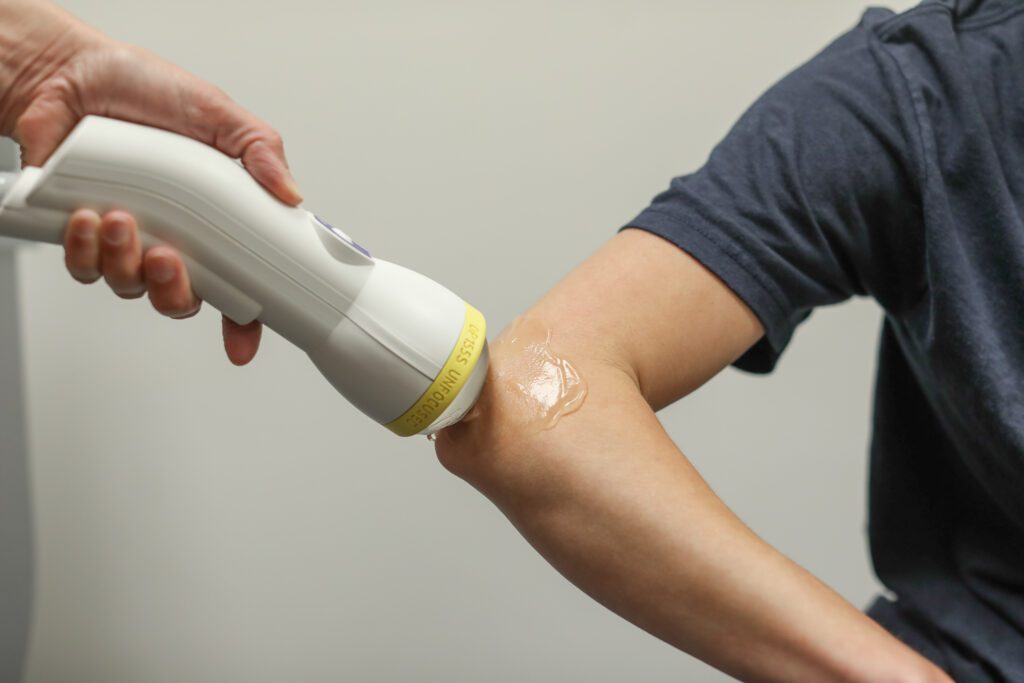
SoftWave is different from both of the above. It uses an electrohydraulic spark gap to generate a true shockwave and then spreads that wave across a broad, parallel field. The result is a wave that reaches up to 7 cm deep but covers a much wider treatment zone than a focused device — and is far more comfortable to receive.
That combination of depth, breadth, and comfort is why SoftWave is the only device with FDA 510(k) clearance specifically for the activation of connective tissue and improved blood supply. That clearance reflects what makes it different: SoftWave isn't just breaking up scar tissue mechanically, it's signaling the body to regenerate tissue at a cellular level.
Side-by-side comparison
| Radial pressure-wave | Focused shockwave | SoftWave broad-focus | |
|---|---|---|---|
| Wave type | Pressure wave (not a true shockwave) | True shockwave, single focal point | True electrohydraulic shockwave, parallel broad field |
| Effective depth | Roughly 1–2 cm | Deep, but only at the focal point | Up to 7 cm across a wide zone |
| Comfort | Surface stinging; skin often red afterward | Can require local anesthesia | Firm tapping; no anesthesia needed |
| Operator dependence | Low, but limited results at depth | High — the focal point must be aimed precisely | Low — broad field covers the whole area |
| Session length | 5–15 minutes | 10–20 minutes | About 10 minutes |
| Downtime | None, some surface soreness | Possible soreness, anesthesia recovery | None — drive yourself home, resume activity |
| FDA 510(k) clearance | Varies by device, typically pain/massage claims | Varies by device and indication | Cleared for activation of connective tissue and improved blood supply |
In our Solana Beach office the practical difference shows up most in conditions that are spread across an area rather than concentrated at one spot — knee arthritis, rotator cuff pain, plantar fasciitis, and neuropathy. See our $49 new patient special if you want to feel the difference before committing to a plan.
Why broad-focus matters for results
In real-world conditions, you rarely have a single point of damage. A patient with chronic shoulder pain, for example, usually has multiple involved structures — the rotator cuff, the joint capsule, the subacromial bursa, and the surrounding musculature. A broad-focus wave treats all of those layers in a single session, instead of forcing the practitioner to hunt for a single focal point.
The same is true for knee arthritis, plantar fasciitis, and back pain. When the underlying problem is spread across an area rather than concentrated in one spot, a broad-focus shockwave addresses the whole picture instead of one slice of it.
Comfort, time, and recovery
SoftWave sessions take about ten minutes and require no anesthesia. Most patients describe the sensation as a firm tapping or thumping — strong, but not painful. There's no downtime afterward; you can drive yourself home and return to normal activity the same day.
Compare that to focused shockwave with local anesthesia, or radial pressure-wave sessions that leave the skin red and tender from repeated surface impact. SoftWave's profile makes it well suited for older patients, athletes mid-season, and anyone who can't afford to lose days to recovery.
How to evaluate any shockwave provider
If you're shopping around, ask the office a few specific questions before you commit:
- What brand and model of device do you use? (If they don't know, that's a red flag.)
- Is it a radial pressure-wave, focused, or unfocused/broad-focus device?
- What FDA clearances does the device hold?
- How deep does it penetrate, and is that enough to reach my injury?
- How many sessions do you typically recommend for my condition?
You can also read our SoftWave therapy overview for more on why we selected this specific technology for our Solana Beach practice, and our office tour if you'd like to see the equipment before you visit.
Bottom line
All three device categories have their place, but they aren't interchangeable. If your condition is superficial and you need short-term muscle release, radial pressure-wave can help. If you need pinpoint treatment of a deep, focal injury and don't mind anesthesia, focused shockwave can work. But for the majority of chronic musculoskeletal and tendon conditions we see in our office, broad-focus SoftWave gives the best combination of depth, comfort, and regenerative effect — which is why we use it. To find out whether SoftWave is right for your situation, contact us to schedule a consultation.
Ready to find out if SoftWave can help you?
Get our $49 new patient special — consultation, exam, and a sample SoftWave treatment.