Is SoftWave Therapy Safe? Side Effects, Risks, and What to Expect
SoftWave has an excellent safety profile, but no treatment is right for everyone. Here's a transparent look at the real risks, contraindications, and what to expect at every session.
When a treatment sounds almost too good to be true — non-invasive, drug-free, no downtime, no needles — it's natural and healthy to ask: what's the catch? Where are the side effects? Who shouldn't get this? This article is a transparent look at SoftWave's safety profile, the genuine contraindications we screen for, and what every patient should know before their first session at our Solana Beach clinic.
Is SoftWave FDA-cleared?
Yes. SoftWave holds FDA 510(k) clearance for the activation of connective tissue and improved blood supply — which is the regenerative mechanism behind everything the therapy does. It's also been used extensively in Europe and worldwide for decades under the broader extracorporeal shockwave therapy (ESWT) umbrella. For background on the underlying technology, see WebMD's overview of shockwave therapy.
Side effects are typically mild and short-lived
Most SoftWave patients report no side effects at all. The ones that do occur tend to be mild and resolve on their own within a day or two. The most common include:
- Mild soreness, achiness, or fatigue in the treated area for 24 to 48 hours
- Temporary redness, warmth, or minor skin irritation
- A brief increase in symptoms before improvement — sometimes called a 'healing response'
- Occasional pinpoint bruising, especially in patients on blood thinners
These responses aren't side effects in the conventional sense — they're often signs the body is mounting the inflammatory and regenerative cascade that SoftWave is designed to trigger. If anything feels unusual, we want you to call us. We'd rather take a question over the phone than have you guess.
Who should not get SoftWave
There are several situations where SoftWave is not appropriate, either because the safety data is limited or because the treatment could complicate another condition. We screen for all of these at your first visit. SoftWave is generally not recommended for patients who are:
- Pregnant — there is not enough safety data to use shockwave during pregnancy
- Being actively treated for cancer in or near the treatment area
- Living with an active infection or open wound at the treatment site
- On blood thinners (case by case — we evaluate dose and risk individually)
- Living with a pacemaker, defibrillator, or other implanted electronic device near the treatment site
- Treating an area directly over a growth plate in skeletally immature patients
If you have any of these factors, we'll either modify the treatment plan or, in some cases, recommend an alternative. Honesty is the policy — if SoftWave isn't a fit, we'll tell you.
What a session actually feels like
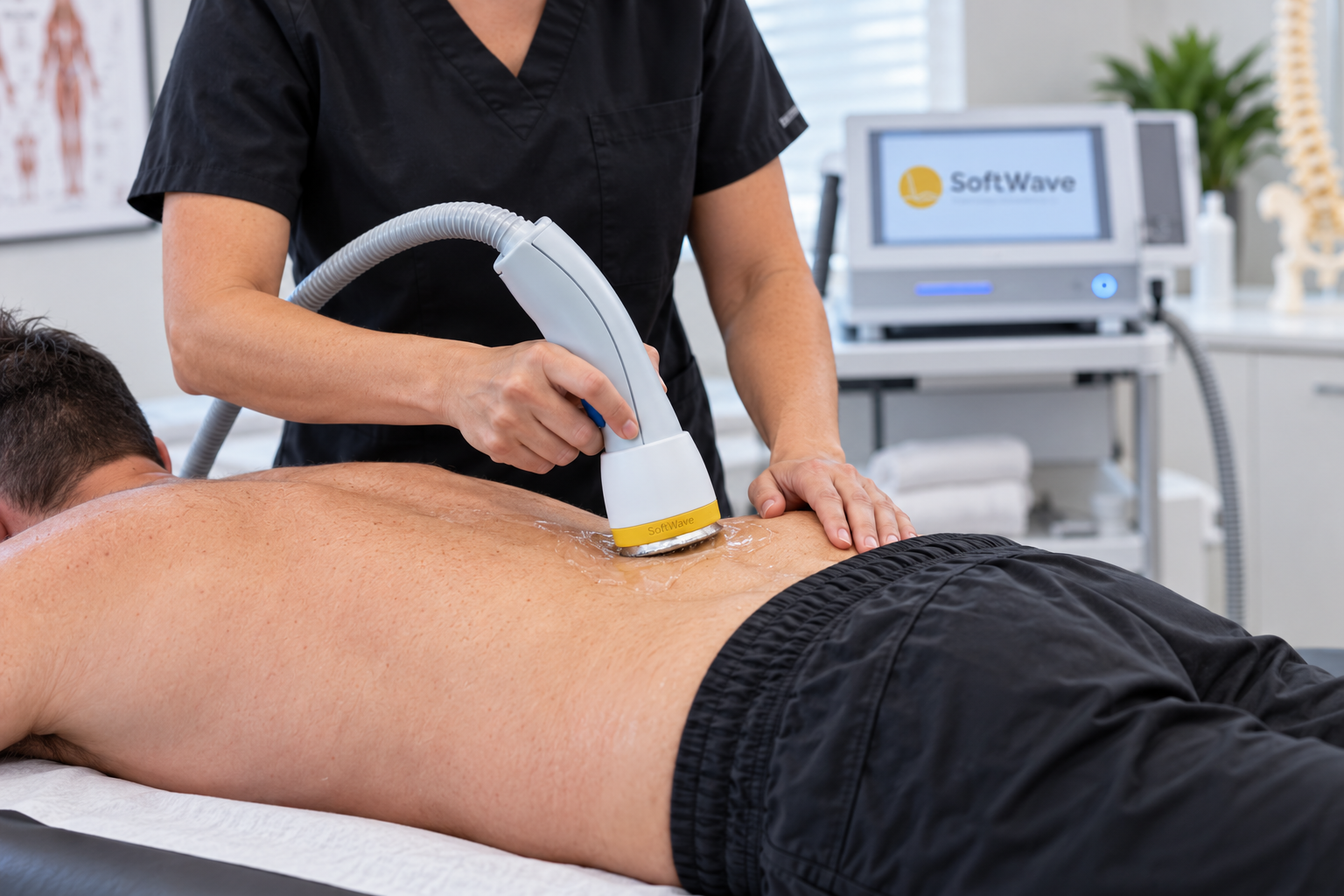
During a SoftWave session, the applicator delivers thousands of acoustic pulses across the treatment zone. Most patients describe the sensation as a firm, rhythmic tapping or thumping — strong, but well within the normal range of medical procedures. It does not require anesthesia, and there's no recovery period afterward.
If a particular spot is unusually sensitive, we can adjust intensity in real time. Some patients are surprised by how strong a particular trigger point feels — that's often a useful sign that we've found exactly the tissue that needed treatment.
What patients should do before and after a session
There's no special prep required before a SoftWave session. Show up in comfortable clothing that gives easy access to the area being treated, and bring any imaging or medical records that might be relevant. After the session, the only general guidance is to stay normally hydrated and avoid heavy ice or anti-inflammatory medications immediately afterward — the inflammatory response that SoftWave creates is part of how it works, and you don't want to blunt it.
Most patients return to work, exercise, or normal daily activity right after the appointment. For certain conditions like Achilles tendonitis or tennis elbow, we may recommend a brief period of load modification to give the tissue room to adapt.
Long-term safety profile
Shockwave therapy has been used in clinical settings for more than three decades — originally to break up kidney stones, and increasingly for musculoskeletal conditions over the last 20 years. The long-term safety record is excellent, and there is no known cumulative risk from repeated courses of treatment. Patients who benefit from an initial course and want a 'tune-up' six or twelve months later can do so safely.
Bottom line on safety
SoftWave is among the safest interventional treatments available for chronic musculoskeletal pain. Side effects are mild, contraindications are well defined, and the long-term track record is strong. We screen every patient carefully at the first visit, walk through your full medical history, and make sure SoftWave is the right tool for your situation before we begin.
If you'd like to learn more before your visit, read our SoftWave therapy overview, browse common questions on our FAQ page, or contact us directly and we'll answer any questions you have.
Ready to find out if SoftWave can help you?
Get our $49 new patient special — consultation, exam, and a sample SoftWave treatment.