
Shockwave Therapy for a Meniscus Tear: Can It Help You Avoid Knee Surgery?
An MRI says "meniscus tear" and the next sentence is usually "arthroscopy." For many degenerative tears, though, surgery is no better than conservative care — which is where shockwave therapy enters the conversation.
You twisted while getting out of the car, or squatted down in the garden, and something in your knee caught. Weeks later it still clicks, swells after activity and aches along the joint line. The MRI report says meniscus tear, and the conversation turns quickly to arthroscopic surgery.
It is worth slowing that conversation down. Not every meniscus tear behaves the same way, and for the most common type in adults over 40, surgery has repeatedly failed to outperform non-surgical care in controlled trials.
Two Very Different Kinds of Meniscus Tear
The meniscus is a C-shaped pad of cartilage that cushions and stabilizes the knee. How a tear happened matters more than the word on the report.
- **Acute traumatic tears** — a clear injury, often in sport, sometimes with the knee locking or refusing to straighten. These may genuinely need surgical repair, especially in younger patients.
- **Degenerative tears** — the tissue frays gradually with age and load, often alongside early arthritis. Pain builds without a single dramatic moment. These make up the majority of tears found on MRI in midlife and beyond.
A locked knee that cannot fully extend is a red flag and warrants an orthopedic opinion promptly. A knee that aches, swells and grumbles is a different situation, and one where regenerative approaches are reasonable to try first.
What the Research Says About Surgery for Degenerative Tears
Multiple randomized trials have compared arthroscopic partial meniscectomy against sham surgery or supervised exercise for degenerative tears, and found no meaningful long-term advantage for the operation. Reviews from the American Academy of Orthopaedic Surgeons and summaries of meniscus care at Mayo Clinic both emphasize conservative management first for this group.
That matters because removing meniscus tissue reduces the knee's shock absorption, which is associated with faster progression of osteoarthritis over the following years.
How Shockwave Therapy Works on the Knee
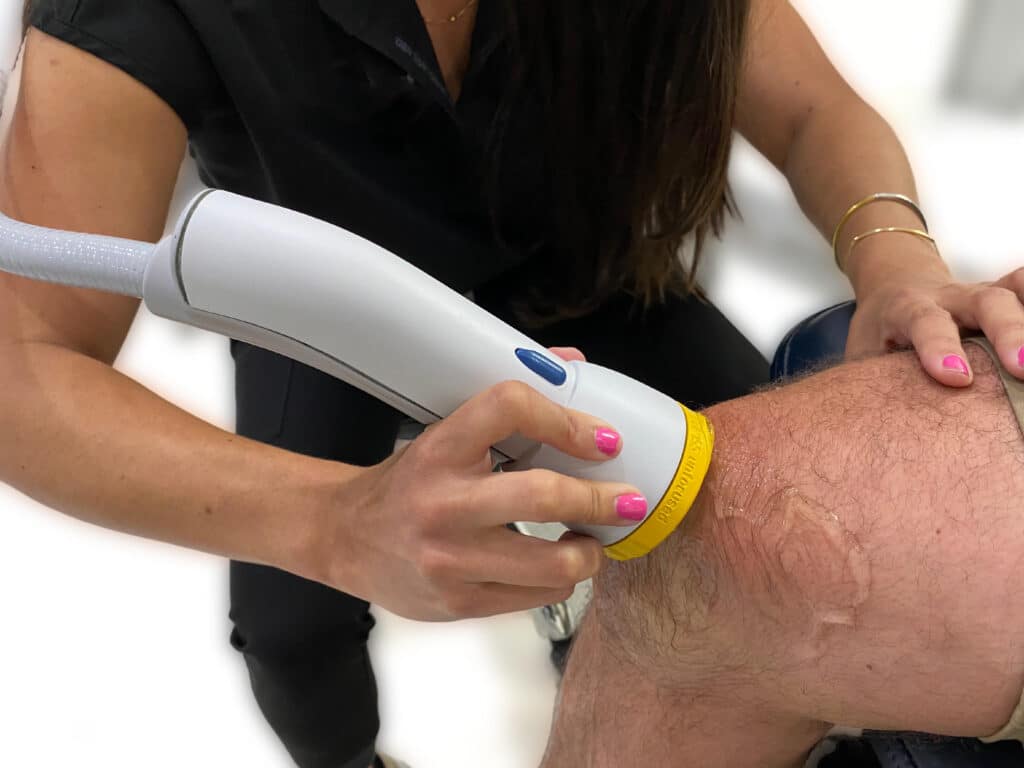
SoftWave TRT delivers unfocused acoustic waves through the tissue around the joint. The waves create a mechanical stimulus that increases local blood flow, triggers the release of growth factors and recruits the body's own repair cells to the treated area — a process usually described as mechanotransduction. Overviews of shockwave mechanisms in musculoskeletal medicine are available through the National Library of Medicine.
Shockwave does not stitch cartilage back together. What it can do is improve the environment around a painful, irritated knee: less inflammation, better circulation, calmer surrounding tendons and ligaments, and often a real reduction in pain that lets you strengthen the leg again.
Who Tends to Respond Well
- Degenerative meniscus pain with early arthritis changes
- Lingering joint-line soreness months after an injury settled
- Knees that hurt on stairs, squatting and rising from a chair
- Patients who want to avoid or delay surgery, or who are not surgical candidates
- Post-surgical knees still painful after arthroscopy
A locked knee, a large displaced flap tear, or significant instability belongs with an orthopedic surgeon first. We will tell you plainly if that is what your exam suggests.
What Treatment Looks Like Here
Sessions take roughly 10 to 15 minutes on the knee. There are no needles, no numbing agent and no downtime — you walk in, get treated and drive yourself home. Most patients feel a firm tapping sensation and mild soreness for a day afterward. Typical care runs three to six sessions spaced about a week apart, and many people notice a change within the first two or three. Results vary.
You can read more about our approach on the knee pain page and about how a torn meniscus specifically is managed on the meniscus tear page.
Shockwave, Injections or Surgery?
| Option | What it does | Trade-offs |
|---|---|---|
| Cortisone injection | Suppresses inflammation for weeks to months | Repeated use can weaken cartilage and tendon tissue |
| Arthroscopic surgery | Trims the torn portion of meniscus | Little benefit for degenerative tears; removes shock absorption |
| Shockwave therapy | Stimulates circulation and the body's repair response | Takes several sessions; not for locked or unstable knees |
We compare the first two in more detail in our article on shockwave therapy vs. cortisone injections.
Frequently Asked Questions
Can shockwave therapy heal a torn meniscus?
It does not repair the tear mechanically. It targets the pain, inflammation and poor circulation around the joint, which is often what actually limits you day to day.
Is it safe if I already have knee arthritis?
Yes — arthritic knees are among the most common ones we treat, and the same tissue-level effects apply.
How soon could I notice a difference?
Many patients report less pain within two or three sessions, with continued improvement over the following weeks. Some need the full series before it turns.
What does the first visit cost?
Our $129 new patient visit covers the doctor consultation, examination and a trial treatment of up to three areas. Full pricing is on the SoftWave therapy cost page.
If your knee has been graded on an MRI and you would rather explore repair than removal, come in and get it looked at properly. Contact us or book the $129 first visit.
Ready to find out if SoftWave can help you?
Get our $129 new patient special — consultation, exam, and a sample SoftWave treatment.