Can SoftWave Therapy Help Achilles Tendonitis Heal Faster?
SoftWave Therapy for Achilles Tendonitis may help some people manage persistent tendon pain alongside rehabilitation. However, faster tendon healing with this specific device has not been established, and pain relief is not the same as a fully recovered tendon.
What Is Achilles Tendonitis?
The Achilles tendon connects your calf muscles to your heel bone and helps you push off when walking, running, or climbing stairs. Repeated loading, especially after a sudden increase in activity, can cause pain and stiffness. Although Achilles tendonitis is a familiar term, persistent symptoms are often described as tendinopathy: changes in the tendon that are not simply ongoing inflammation.
The American Academy of Orthopaedic Surgeons' Achilles tendinitis guide distinguishes pain where the tendon attaches to the heel, called insertional tendinopathy, from pain higher up the tendon, called noninsertional or midportion tendinopathy. That distinction matters because exercises and treatment choices may differ.
- Pain or stiffness at the back of the heel or above it, particularly in the morning.
- Discomfort that increases with running, jumping, hills, or repeated push-offs.
- Tenderness, swelling, or thickening along the tendon.
- Symptoms that keep returning when you resume your usual activities.
How Does SoftWave Therapy for Achilles Tendonitis Work?
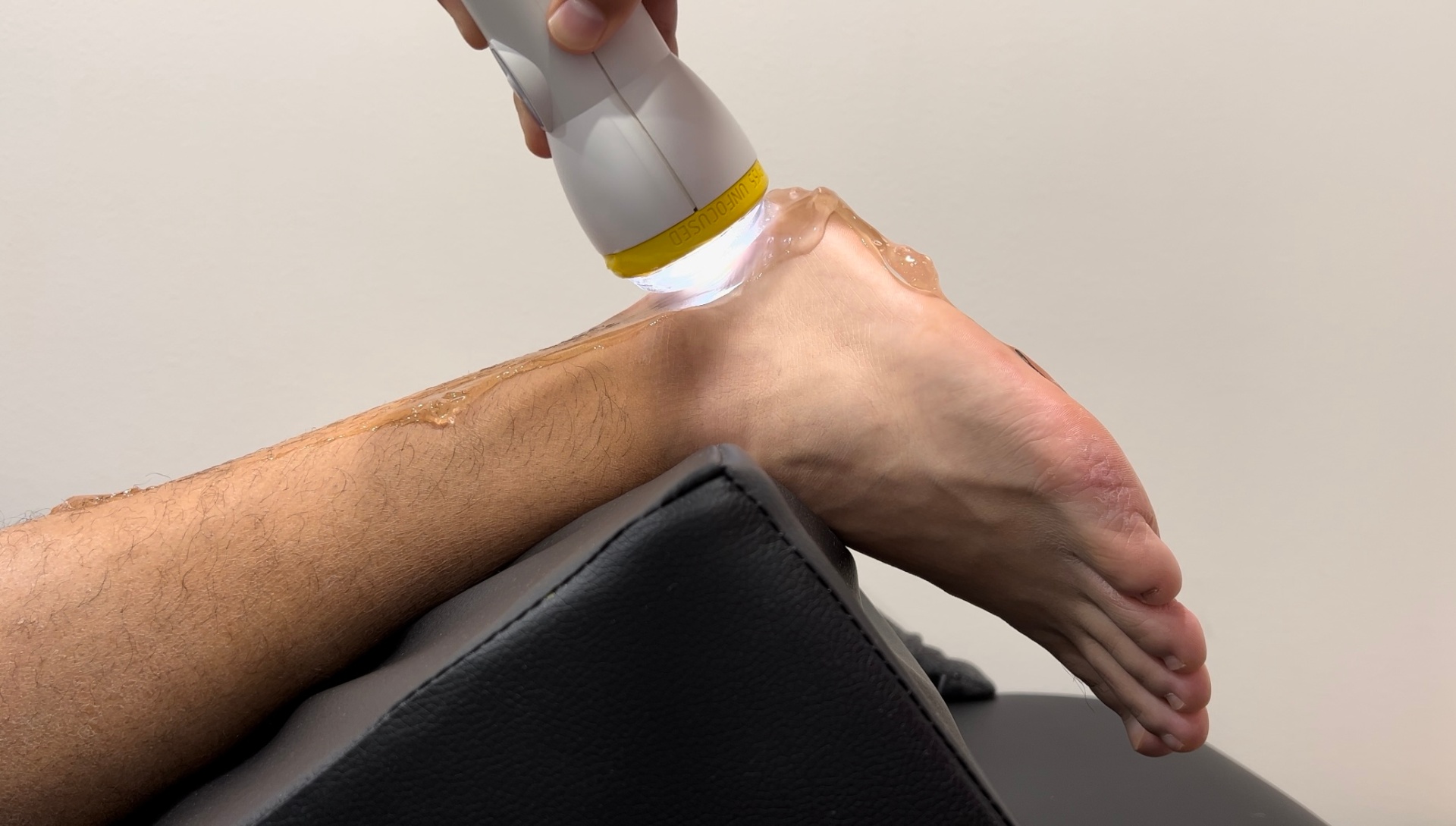
SoftWave TRT uses unfocused electrohydraulic acoustic waves delivered through an applicator over the treatment area. It is a form of extracorporeal shockwave therapy, or ESWT. Shockwave treatment is studied for its effects on pain and tendon recovery, but proposed biological effects should not be mistaken for proof that a particular patient's tendon has healed.
An evaluation comes first: posterior heel pain can have several causes, and treatment should match the diagnosis. Learn about the clinic's approach on our Achilles tendonitis treatment page.
Can It Actually Help the Tendon Heal Faster?
The most useful distinction is between feeling better and rebuilding the tendon's capacity to handle load. Some studies of shockwave therapy report better pain and function when it is added to rehabilitation. Those outcomes do not establish that SoftWave specifically shortens tendon healing time or gets every patient back to sport sooner.
A systematic review of shockwave therapy for Achilles tendinopathy found evidence supporting ESWT added to tendon loading for midportion symptoms, but did not find comparable support for insertional symptoms. Evidence varies by device, treatment settings, and comparison treatment. Research using focused or radial shockwave equipment cannot automatically be applied to SoftWave's unfocused electrohydraulic technology. Ask your clinician what evidence fits your diagnosis and what improvement would count as a worthwhile response.
Rehabilitation Still Matters
Progressive calf and tendon strengthening, together with adjustments to aggravating activity, remains an important part of care. Shockwave therapy should not replace a rehabilitation plan. If pain improves, your tendon may still need a gradual increase in strength and tolerance before it can safely handle running or jumping.
- Review recent changes in mileage, hills, jumping, or footwear with your clinician.
- Use a strengthening plan suited to the location and severity of your symptoms.
- Avoid assuming that less pain means you are ready for unrestricted sport.
- Track morning stiffness, walking comfort, calf strength, and your response to activity over time.
For insertional pain, exercises that lower the heel deeply below a step can aggravate symptoms in some people. Your clinician can adapt the range of movement rather than giving everyone the same heel-drop program. Return-to-running decisions should reflect your function and symptom response, not just the number of treatments completed.
What to Expect at an Achilles Evaluation
At SoftWave Solana Beach, an evaluation can help determine whether your symptoms are consistent with Achilles tendinopathy and whether SoftWave is appropriate to consider. Discuss how long you have had pain, previous injuries, medication use, and any exercise or physical therapy you have already tried. Imaging or referral may be appropriate when the diagnosis is uncertain or a tear is suspected.
If treatment is appropriate, discuss comfort, possible soreness, activity guidance, and when progress will be reassessed. There is no universal session count or guaranteed recovery date. A plan should be reviewed if symptoms worsen or meaningful progress is not occurring, rather than automatically adding more visits.
When Achilles Pain Needs Prompt Medical Attention
A sudden pop or snap, severe pain near the heel, or difficulty pushing off or standing on your toes can indicate an Achilles rupture. Seek prompt medical assessment instead of scheduling routine shockwave treatment. The Mayo Clinic's Achilles tendon rupture overview explains these warning signs. SoftWave is not a substitute for evaluation of a possible tear.
SoftWave Therapy for Achilles Tendonitis in Solana Beach
If Achilles pain is limiting your walks, workouts, or daily activities in Solana Beach or North County San Diego, start with a clear diagnosis and realistic expectations. Our $49 new patient special includes a consultation, full evaluation, and first treatment for one area. Review our SoftWave therapy pricing, or contact SoftWave Solana Beach to discuss an evaluation.
Frequently Asked Questions
Is SoftWave a replacement for physical therapy?
No. Tendon strengthening and appropriate load management remain important. SoftWave may be considered as an additional treatment, depending on your evaluation and response to care.
Can I keep running during treatment?
That depends on your symptoms and tendon function. Your clinician may recommend reducing or modifying running while rebuilding load tolerance. Pain relief after a session is not clearance to increase mileage.
How quickly will my Achilles recover?
Persistent Achilles tendinopathy can take months to improve, and recovery varies. SoftWave cannot guarantee faster healing. Reassessment should consider both symptoms and your ability to tolerate activity.
Ready to find out if SoftWave can help you?
Get our $49 new patient special — consultation, exam, and a sample SoftWave treatment.