
Shockwave Therapy for Frozen Shoulder: Getting Motion Back Without Surgery
Adhesive capsulitis is famous for one thing: how long it lasts. Here is what is actually happening inside the joint, and where shockwave therapy fits alongside stretching and injections.
Frozen shoulder rarely announces itself. It starts as an ache you blame on sleeping badly, then one morning you reach for the seatbelt and the arm simply refuses. Combing your hair, fastening a bra, pulling on a jacket — ordinary movements become negotiations.
The clinical name is adhesive capsulitis. The capsule surrounding the shoulder joint thickens, tightens and loses its glide, and the joint physically runs out of room to move. Left completely alone, the whole cycle commonly takes one to three years, as described by Mayo Clinic.
The Three Stages
- **Freezing** — pain leads, motion starts to disappear. Nights are worst. Typically six weeks to nine months.
- **Frozen** — pain settles somewhat but stiffness dominates. Four to twelve months.
- **Thawing** — motion gradually returns over six months to two years.
Knowing your stage matters, because aggressive stretching during the freezing phase often makes things angrier, while the frozen phase responds better to work on the capsule itself.
Who Gets It
- Adults between roughly 40 and 60, women more often than men
- People with diabetes — the risk is substantially higher, per the American Academy of Orthopaedic Surgeons
- Thyroid disorders and cardiovascular disease
- Anyone whose shoulder was immobilized after surgery, a fracture or a rotator cuff injury
How Shockwave Therapy Helps a Stiff Capsule
SoftWave TRT sends unfocused acoustic waves into the tissue around the joint. Three effects matter here: increased local blood flow, a reduction in inflammatory signaling, and mechanical stimulation of the fibrous, thickened tissue that is restricting movement. Research on shockwave for shoulder conditions, including calcific tendinopathy and adhesive capsulitis, is collected in the National Library of Medicine.
In practice, the meaningful win is usually pain relief that opens a window for movement. A shoulder that hurts less will tolerate the stretching and mobility work that actually restores range, so shockwave and rehabilitation work best together rather than as alternatives.
What a Session Involves
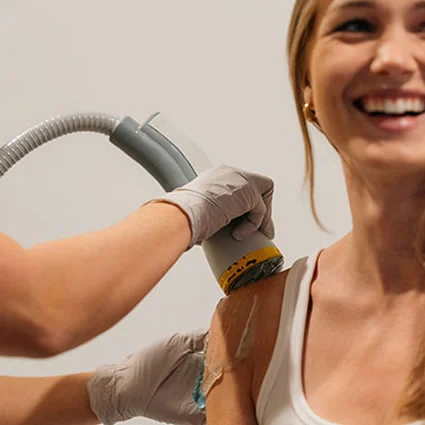
Treatment takes about 10 to 15 minutes. Gel is applied, the applicator moves over the shoulder, and you feel a firm tapping. Nothing is injected, nothing is numbed and there is no downtime — you can drive home and go back to work. Most patients are seen weekly for three to six sessions. Many report better sleep and easier reaching within the first few visits, though frozen shoulder is stubborn and results vary.
More detail lives on our frozen shoulder page, and our rotator cuff and shoulder pain article covers the neighboring diagnoses that are often confused with it.
Comparing Your Options
| Option | Best used for | Considerations |
|---|---|---|
| Physical therapy | Restoring range in the frozen and thawing stages | Slow; painful if pushed too early |
| Cortisone injection | Calming a very painful freezing-stage shoulder | Temporary; repeat use has tissue costs |
| Shockwave therapy | Reducing pain and stimulating the capsule so motion work becomes possible | Several sessions needed; works best paired with movement |
| Capsular release / manipulation | Severe cases that fail everything else | Surgical risk and a rehabilitation period |
Frequently Asked Questions
Is shockwave therapy painful on a frozen shoulder?
It is uncomfortable rather than painful, and intensity is dialed to your tolerance. Mild soreness for a day afterward is normal.
Can I be treated during the painful freezing stage?
Yes, and that is often when pain relief is most valuable. We keep energy conservative early on.
How many sessions will I need?
Usually three to six to know whether it is working, sometimes more for a long-standing frozen shoulder.
Will insurance cover it?
Typically not. The $129 first visit includes consultation, exam and a trial treatment — see the cost page.
If your shoulder has been getting quietly smaller in what it will let you do, have it examined before another year passes. Contact us to get started.
Ready to find out if SoftWave can help you?
Get our $129 new patient special — consultation, exam, and a sample SoftWave treatment.