
Pickleball Elbow and Shoulder Pain: How to Treat It Without Surgery
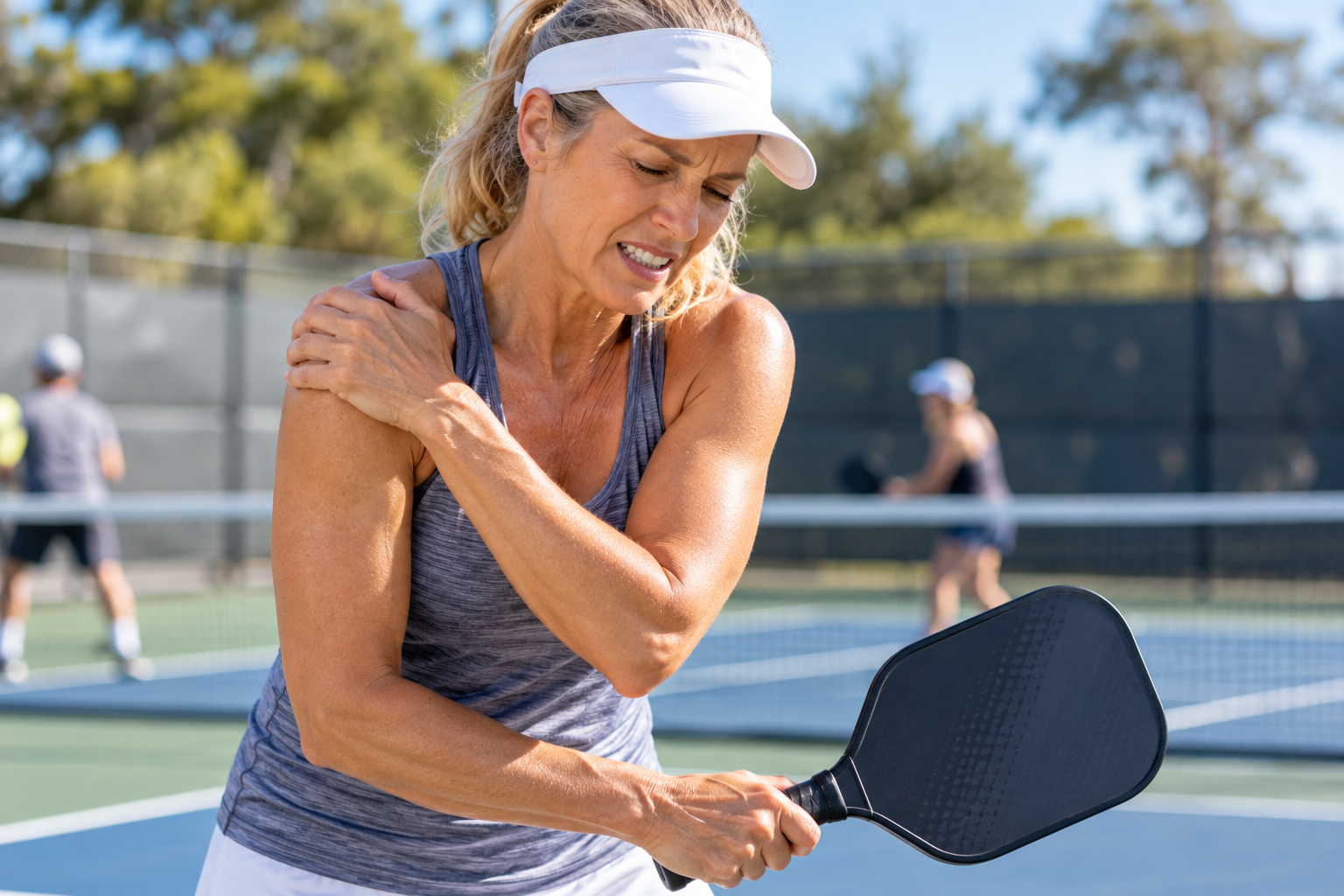
Pickleball is the fastest-growing sport in the country — and pickleball elbow, rotator cuff strain, and wrist pain are showing up in our Solana Beach office every week. Here's how to recover without surgery or steroids.
Pickleball has taken over North County. Courts at Fletcher Cove, La Colonia Park, and every rec center from Encinitas to Del Mar are booked from sunrise to sunset — and the injuries are stacking up just as fast. The most common complaints we see in our Solana Beach office are pickleball elbow, rotator cuff strain, wrist tendonitis, and Achilles pain, and most of the patients arriving with them are 45 and up.
The good news: almost none of these injuries need surgery. The bad news: the standard cortisone-and-rest cycle rarely gets weekend players back on the court for good. This guide covers what's really happening in the joint, why the injury keeps coming back, and how SoftWave shockwave therapy resolves the underlying tissue damage so you can play pain-free.
Why pickleball injuries are exploding
According to a UBS Securities analysis reported by the Association of American Medical Colleges, pickleball-related injuries are projected to cost the U.S. healthcare system nearly $400 million per year. The sport looks low-impact, but the underhand serve, quick pivots, and repetitive wrist snap create the same overuse patterns as tennis — often in bodies that haven't played a racquet sport in decades.
Add in inconsistent warm-ups, aging tendons with reduced blood supply, and multi-hour open-play sessions, and you have the perfect recipe for chronic tendinopathy. That's why the same players keep coming back with the same elbow or shoulder pain month after month.
Pickleball elbow (lateral epicondylitis)
Pickleball elbow is the same condition tennis players know as lateral epicondylitis — degeneration of the tendon that anchors the wrist extensors to the outside of the elbow. The paddle grip, wrist flick, and repeated backhand load that tendon thousands of times per session, and over weeks or months the tissue breaks down faster than it can rebuild.
The hallmarks are a sharp or aching pain on the outside of the elbow, weakness when you grip the paddle or lift a coffee cup, and stiffness in the forearm the morning after playing. Cortisone injections offer short-term relief but weaken the tendon over time, which is why we cover the tradeoffs in detail in our post on SoftWave vs cortisone injections.
Rotator cuff and shoulder pain
The overhead serve, high volley, and reach-back on wide shots all load the rotator cuff — a group of four small stabilizing muscles that keep the shoulder centered in the joint. In players over 45, those tendons already have reduced blood flow and small age-related tears, and pickleball simply reveals what's been building for years.
Common signs include a deep ache in the shoulder that's worst at night, pain reaching overhead or behind your back, and a 'catching' sensation on certain swings. Left untreated, the tissue continues to fray and can progress to a full-thickness tear. Our shoulder pain treatment page covers the clinical approach in more depth.
Why rest alone doesn't fix it
Tendon injuries live in a difficult zone: tendons have poor blood supply to begin with, and once they become chronically degenerated (tendinosis rather than tendonitis) the body largely stops trying to repair them. You can rest for six weeks, feel great, come back on the court, and re-injure the same tendon on the second game.
That's why the treatments that actually work long-term are the ones that re-start the healing process — not the ones that just quiet down the pain.
How SoftWave shockwave therapy treats pickleball injuries
SoftWave delivers true, unfocused acoustic shockwaves up to 7 cm deep into the affected tendon. Inside the tissue, the mechanical energy stimulates three things: new blood vessel formation (angiogenesis), release of growth factors like VEGF that rebuild collagen, and activation of resident stem cells that repair the chronic micro-injury. For a plain-English overview of how the technology works, see our guide on what SoftWave TRT shockwave therapy is.
Most pickleball patients complete 6 to 8 sessions over 4 to 6 weeks. Each session takes about 10 minutes, requires no anesthesia, and you can play (lightly) between visits — we'll give you specific guidance on load management. Many players notice meaningful change by the third or fourth session, with continued improvement for months afterward as the regenerative cascade plays out.
What to do this week
- Back off from tournament play and open-play marathons — swap to shorter sessions until the tendon calms down.
- Warm up your shoulders, wrists, and elbows for 5 minutes before the first game (arm circles, band pull-aparts, wrist rolls).
- Check your paddle grip size — an undersized grip forces the forearm to work harder and accelerates elbow tendinopathy.
- Ice for 10 minutes after play if the joint is warm or swollen; skip NSAIDs if you can, since they can blunt tendon healing.
- If pain persists past two weeks, get evaluated before it becomes a chronic tendinosis.
When to come in
If pickleball pain is starting to change how you play — shorter sessions, skipped days, avoiding backhands, ice packs after every game — that's the window where regenerative treatment works best. Waiting six months or a year usually means a longer course of care and slower progress.
Contact our Solana Beach office to schedule an evaluation, or book online. We'll examine the joint, review your play history, and lay out an honest plan — whether that's SoftWave, load management, or a referral for imaging.
Ready to find out if SoftWave can help you?
Get our $49 new patient special — consultation, exam, and a sample SoftWave treatment.