
Pelvic Floor Therapy for Women: Can It Help Bladder Leakage, Urgency & Postpartum Weakness?
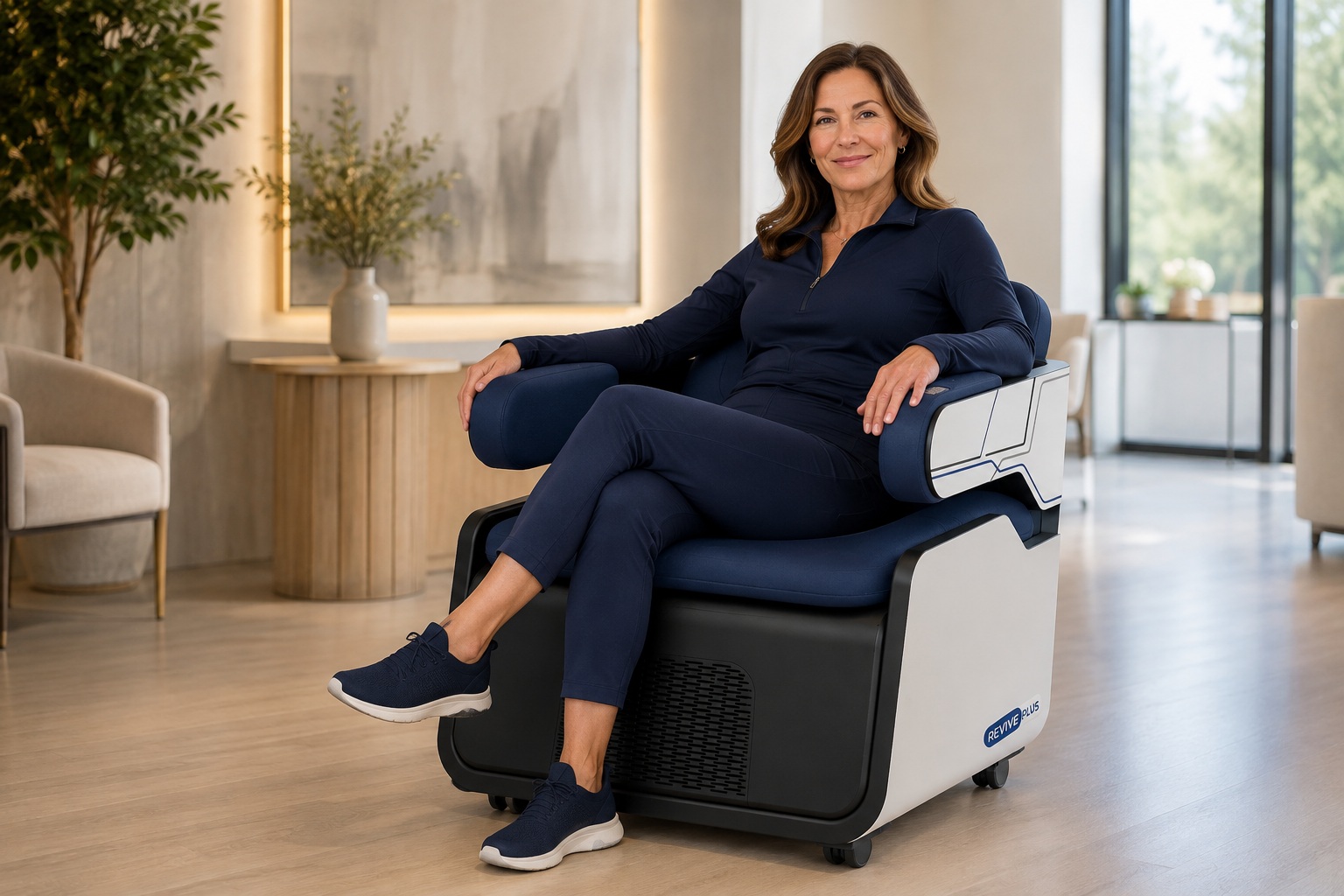
Why do you leak when you sneeze? Why does the urge hit so fast? A look at what changes in the female pelvic floor after pregnancy, childbirth and midlife — and how chair-based therapy fits in.
"Why do I leak urine when I sneeze?" It is one of the most-searched questions women ask in private, and one of the least-discussed out loud. The same goes for the urge that arrives out of nowhere, the map of bathrooms you keep in your head, and the feeling that something never quite bounced back after your last baby.
None of that is a character flaw or an inevitable part of being a woman. In most cases it traces back to one specific group of muscles — the pelvic floor — and muscles can be retrained. This guide walks through what the female pelvic floor does, what weakens it, and where pelvic floor therapy for women fits among the options.
What Is the Female Pelvic Floor?
The pelvic floor is a hammock of muscles and connective tissue that stretches from your pubic bone to your tailbone, side to side between your sit bones. It closes the base of the pelvis and holds up the bladder, the uterus and the rectum.
Three jobs matter most day to day: keeping the urethra closed until you choose otherwise, supporting the pelvic organs against gravity and pressure, and contributing to sexual sensation and comfort. It also coordinates with your deep abdominals and diaphragm every time you breathe, lift or cough.
Why Pelvic Floor Strength Matters
Every cough, sneeze, laugh, jump and heavy lift sends a spike of downward pressure through the abdomen. A responsive pelvic floor tightens a fraction of a second before that spike and absorbs it. A weak or poorly coordinated one arrives late — and pressure escapes as a leak.
Strength here is not about doing more Kegels harder. It is about muscles that fire at the right moment, with enough endurance to keep doing it through a workout, a long day or a bad cold.
Common Signs of Pelvic Floor Weakness
- Leaking with coughing, sneezing, laughing, running or lifting
- A sudden urge to urinate that is hard to defer
- Frequent bathroom trips, including waking at night
- A feeling of heaviness, pressure or bulging in the vagina
- Reduced vaginal tone or less sensation during intimacy
- Difficulty fully emptying the bladder
- Low back or deep pelvic aching with no clear injury
Pelvic floor weakness in women often shows up as a combination of these rather than a single symptom, and it tends to creep in gradually enough that it gets normalized.
Bladder Leakage When Coughing, Sneezing or Laughing
This is stress urinary incontinence — "stress" meaning mechanical pressure, not emotional stress. The bladder is fine; the closure mechanism simply loses the race against the pressure spike.
Bladder leakage when exercising follows the same pattern: box jumps, running, heavy squats and trampolines are common triggers. Many women quit the activity rather than address the muscles, which is the wrong trade. Conservative pelvic floor muscle training is the recommended first-line approach for stress incontinence in women, according to the National Institute of Diabetes and Digestive and Kidney Diseases.
Urinary Urgency and Frequent Bathroom Trips
Urgency is a different mechanism. Here the bladder muscle contracts before it is full, producing a signal that feels non-negotiable. Some women leak on the way to the bathroom; others simply plan life around proximity to one.
A pelvic floor that contracts well can help damp that reflex, which is why strengthening is often paired with bladder retraining and reducing common irritants such as caffeine and carbonation. The Mayo Clinic outlines how stress and urge incontinence differ and why many women have a mix of both.
Pelvic Floor Changes After Pregnancy
Pregnancy loads the pelvic floor for months regardless of how you deliver. Growing weight sits directly on it, relaxin softens connective tissue, and posture shifts to accommodate the bump. By the third trimester many women already notice leaking or pressure.
Pelvic Floor Changes After Childbirth
Vaginal delivery stretches the pelvic floor muscles and can affect the nerves that supply them, particularly with a long pushing stage, a large baby, forceps or vacuum assistance, or significant tearing. Cesarean birth spares the stretch but not the nine months of load or the abdominal wall recovery.
Pelvic floor therapy after childbirth is not a vanity project. It addresses function: continence, support, core coordination and comfort with intimacy.
Postpartum Pelvic Floor Recovery
Tissue healing takes weeks; muscle strength and coordination take months. Postpartum pelvic floor therapy generally starts after your clinician clears you, then progresses from awareness and breathing to endurance and load.
Leaking that is still present six to twelve weeks after delivery is worth addressing rather than waiting out — the American College of Obstetricians and Gynecologists treats postpartum care as an ongoing process, not a single visit. And "postpartum" has no expiration date: women come in five, ten or twenty years later and still make progress.
Pelvic Floor Changes During Aging
Estrogen decline around perimenopause and menopause thins the tissues of the urethra and vagina and reduces their elasticity. Muscle mass drops across the body, the pelvic floor included, and years of accumulated load add up.
This is why symptoms that were manageable at 35 often become intrusive at 55 — new mechanism, same muscles.
Vaginal Tone and Pelvic Muscle Strength
Vaginal tone is largely a reflection of the surrounding pelvic floor muscles. When they weaken, women describe feeling looser, less supported or less aware of sensation. When they regain strength and resting tone, that awareness typically improves alongside continence.
Pelvic Floor Health and Sexual Function
These muscles contribute to arousal, blood flow and orgasm. Weakness can blunt sensation; excessive guarding and tension can cause discomfort with penetration. Both are pelvic floor problems, and the right approach depends on which pattern you have — one reason a professional assessment beats guessing.
Mild-to-Moderate Pelvic Organ Prolapse
When support slackens, the bladder, uterus or rectal wall can descend into the vaginal canal. Women describe heaviness, a dragging sensation, or a bulge that is worse by evening or after being on their feet.
For mild-to-moderate prolapse, strengthening the supporting muscles can reduce symptoms and is standard conservative care. Advanced prolapse needs gynecologic evaluation, and possibly a pessary or surgery.
Pelvic Pain and Weakness
Not every pelvic floor problem is a weak one. Chronically tight, guarded muscles can produce aching, burning, urinary urgency and painful intercourse while also testing weak, because a muscle held short cannot generate force. If pain is your dominant symptom, say so at your consultation — it changes the plan.
How Pelvic Floor Chair Therapy Works
Chair-based therapy uses a focused electromagnetic field projected up through the seat. That field stimulates the motor nerves of the pelvic floor and triggers strong, involuntary contractions — deeper and far more numerous than you can produce voluntarily.
One 28-minute session on the REVIVE® chair delivers approximately 12,000 contractions. You stay fully clothed. There are no probes, no needles and no undressing. Most women read, scroll or chat through it and drive themselves home afterward.
Full details on pricing and scheduling live on our REVIVE® pelvic floor therapy page.
What Women Can Expect During a REVIVE Session
- A short consultation about your symptoms and history
- You sit fully clothed on the chair, centered over the applicator
- Intensity starts low and builds to a level you tolerate comfortably
- You feel rhythmic tightening and lifting through the pelvic floor
- Approximately 12,000 contractions across a 28-minute session
- No recovery time — you return to your day immediately
Roughly 80% of patients report improvement within four to six sessions. Results vary from person to person, and a first session is generally shortened to about 15 minutes so your body can adjust. If you would rather talk it through first, contact our Solana Beach office or read more about our approach and credentials.
Pelvic Floor Therapy for Women in Solana Beach
Women searching for pelvic floor therapy for women in Solana Beach are usually looking for two things: a non-invasive option, and someone who will not make the conversation awkward. Our office is at 665 San Rodolfo Dr, Unit 109, serving Solana Beach, Del Mar, Encinitas, Rancho Santa Fe and Carmel Valley.
When to Talk With a Healthcare Professional
See a clinician promptly if you have blood in your urine, pain or burning with urination, fever, a visible bulge you can feel outside the vaginal opening, sudden loss of bladder or bowel control, or new pelvic pain. Chair therapy is also not appropriate during pregnancy or with certain implanted metal or electronic devices, which is what the screening consultation is for.
FAQs
Do I have to undress for pelvic floor chair therapy?
No. You remain fully clothed for the entire session. There are no internal probes and no exam table.
Is it safe if I am still breastfeeding?
Breastfeeding is generally not a barrier, but pregnancy is. Bring your full history to the consultation so we can screen you properly.
How soon after giving birth can I start?
After your clinician clears you postpartum, typically around the six-week mark. We will confirm at your consultation.
Will this replace my Kegels?
It builds strength you would struggle to reach voluntarily. Many women continue their own exercises alongside it to maintain gains.
How many sessions will I need?
Most protocols run six to eight sessions, and roughly 80% of patients report improvement within four to six. Your plan depends on your symptoms and history.
Does it hurt?
It should not. The sensation is strong rhythmic tightening, and intensity is adjusted to your comfort throughout.
This article is general education and not a substitute for individual medical advice. Individual results vary.
Ready to find out if SoftWave can help you?
Get our $129 new patient special — consultation, exam, and a sample SoftWave treatment.