
Pelvic Floor Therapy for Men: Bladder Control, Post-Prostate Recovery & Sexual Health
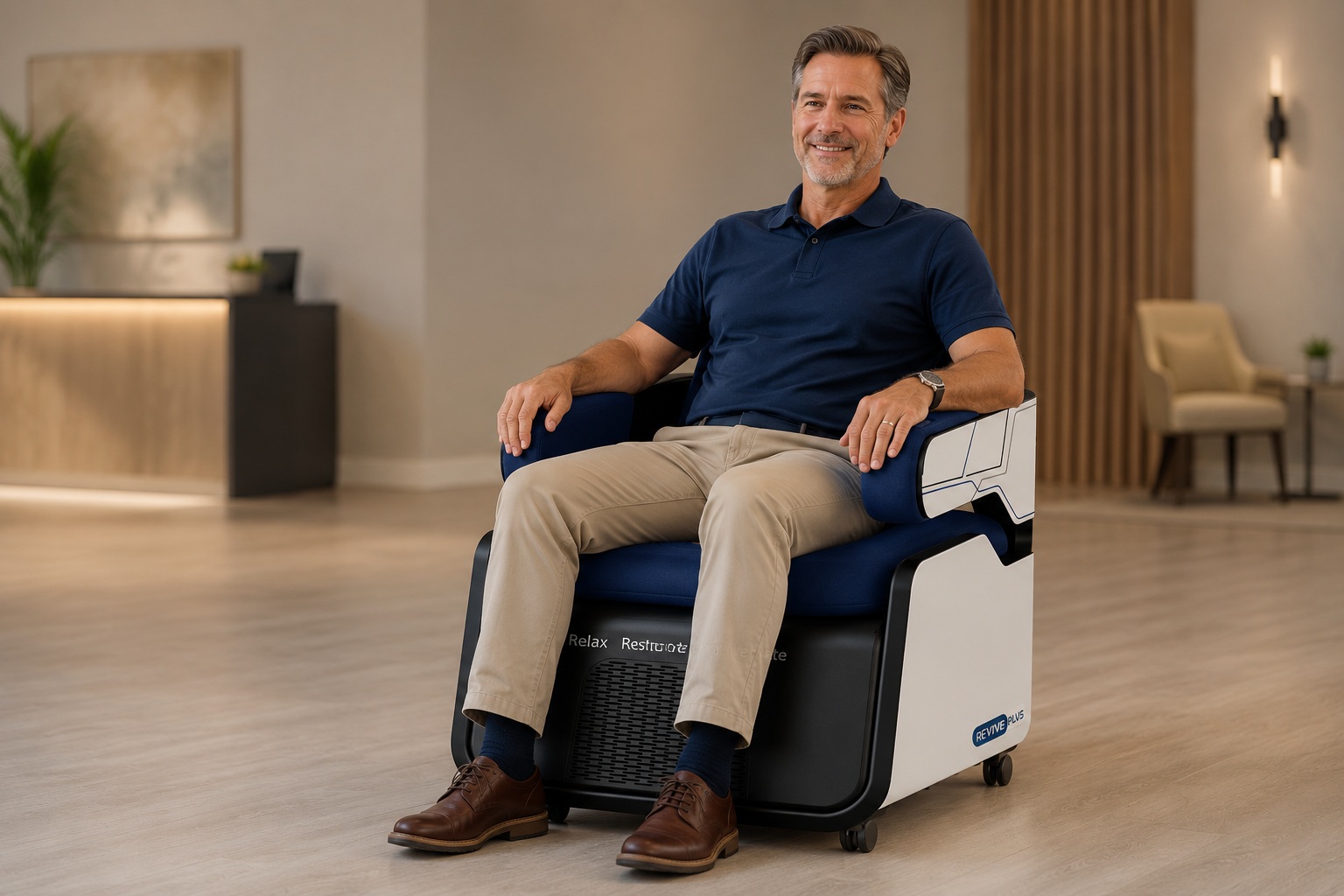
Leaks after a prostate procedure, four bathroom trips a night, softer erections — they often share one cause. Here's what the male pelvic floor does, and how chair-based therapy retrains it fully clothed.
Most men never hear the phrase "pelvic floor" until something goes wrong — a drip after a prostate procedure, a pad in the underwear drawer, four bathroom trips a night, or erections that no longer hold the way they used to. Those problems get filed separately in a man's mind. Very often they share one cause.
Pelvic floor therapy for men targets that shared cause: a group of muscles at the base of the pelvis that control continence, support the bladder and bowel, and contribute directly to erectile firmness. Muscles respond to training — which is what makes this worth understanding rather than tolerating.
What Is the Male Pelvic Floor?
The male pelvic floor is a layered sling of muscle running from the pubic bone back to the tailbone and side to side between the sit bones. It closes the base of the pelvis, wraps the urethra and the base of the penis, and works with the deep abdominals and diaphragm every time you breathe, lift or cough.
Two muscles matter especially for sexual function: the bulbocavernosus and the ischiocavernosus. They compress the veins at the base of the penis to trap blood during an erection, and they drive the rhythmic contractions of ejaculation.
Why Pelvic Floor Strength Matters for Men
Every cough, sneeze, lift and sprint sends downward pressure through the abdomen. A responsive pelvic floor tightens a fraction of a second beforehand and holds the urethra closed. A weak or slow one arrives late, and pressure escapes as a leak.
Strength here is not about squeezing harder for longer. It is about firing at the right moment with enough endurance to keep doing it through a workout, a long meeting or a bad cold — and, for sexual function, enough force to maintain venous compression.
Symptoms of a Weak Pelvic Floor
- Dribbling after urination or leaking with coughing, sneezing, lifting or exercise
- Needing a pad or liner, even a thin one
- Sudden urges that are hard to defer
- Frequent daytime bathroom trips
- Waking once or more each night to urinate
- Erections that start well but soften early
- Reduced ejaculatory force or control
- A vague ache or heaviness between the scrotum and anus
Pelvic floor weakness in men usually shows up as a cluster of these rather than one isolated symptom, and it tends to creep in slowly enough to get written off as aging.
Male Urinary Leakage
Stress leakage — "stress" meaning mechanical pressure, not emotional strain — happens when the closure mechanism loses the race against a pressure spike. The bladder itself is often perfectly healthy. Post-void dribbling is a close cousin: the muscles that should milk the last of the urine out of the urethra do not finish the job.
Pelvic floor muscle training is a recommended conservative starting point for bladder control problems in men, as outlined by the National Institute of Diabetes and Digestive and Kidney Diseases.
Frequent Urination During the Day
Daytime frequency is often urgency rather than volume: the bladder muscle contracts before it is full and produces a signal that feels non-negotiable. Men start mapping bathrooms, skipping water before meetings, and choosing aisle seats.
A pelvic floor that contracts well can help damp that reflex, which is why strengthening is usually paired with bladder retraining and cutting common irritants such as caffeine, alcohol and carbonation. Prostate enlargement can drive the same symptoms, so an evaluation matters — the Mayo Clinic describes how the different patterns of incontinence separate out.
Nighttime Urination / Nocturia
Waking to urinate once may be normal; two, three or four times is not, and it wrecks sleep quality long before anyone connects it to the pelvic floor. Nocturia in men can involve bladder capacity, fluid timing, prostate size, sleep apnea or heart and kidney issues — which is why new or worsening nighttime urination deserves a proper look rather than a guess.
Where weak pelvic floor control and urgency are part of the picture, strengthening tends to improve the ability to defer and get back to sleep.
Pelvic Floor Recovery After Prostate Procedures
Prostate surgery, particularly radical prostatectomy, removes structures that contribute to continence and leaves the pelvic floor to do more of the work. Most men leak afterward. Most also improve — and pelvic floor muscle training is the standard conservative measure used to speed that recovery, as the American Urological Association guidance on incontinence after prostate treatment describes.
Post-prostate pelvic floor therapy is about retraining a system that has lost a component: better closure force, better timing, better endurance through the day. It also supports the return of erectile function, since the same muscles are involved.
Pelvic Floor Muscles and Sexual Function
Erection is a plumbing problem with a muscular valve. Arterial inflow fills the erectile bodies; the pelvic floor muscles then compress the outflow veins to keep that blood in place. Nerve signals and blood vessel health matter enormously — and so does the strength of the muscles doing the trapping.
Pelvic Floor Health and Erectile Quality
When men describe erections that start fine but soften before or during intercourse, insufficient venous compression is one plausible contributor. Strengthening the bulbocavernosus and ischiocavernosus has been used as a conservative approach to erectile difficulty for exactly that reason.
Vascular causes deserve their own attention too. We cover the shockwave side of that in detail on our erectile dysfunction treatment page, and for some men the two approaches complement each other.
Pelvic Floor Strength and Sexual Performance
The same muscles govern ejaculatory force and give you something to work with for control and timing. Men frequently report stronger orgasm intensity and better confidence as pelvic floor strength returns, alongside the continence gains they came in for.
Can Men Benefit From Pelvic Floor Therapy?
Yes — and the assumption that pelvic floor work is a postpartum women's issue is the single biggest reason men wait years. Men come to us for bladder leakage, daytime and nighttime frequency, post-prostate recovery, erectile quality, sexual performance and plain daily control.
What it is not: a fix for every cause. Significant prostate enlargement, neurologic disease, poorly controlled diabetes and advanced vascular disease all need their own management. Screening at the consultation is there to sort that out honestly.
How the REVIVE Pelvic Floor Chair Works
The REVIVE® chair projects a focused high-intensity electromagnetic field up through the seat. That field stimulates the motor nerves of the pelvic floor and triggers supramaximal contractions — deeper and far more numerous than any man can produce voluntarily.
One 28-minute session delivers approximately 12,000 contractions. No Kegel routine comes close. Pricing, protocols and scheduling are on our REVIVE® pelvic floor therapy page.
What a Session Is Like for Men
- A short private consultation about symptoms, history and any prostate treatment
- You sit on the chair, centered over the applicator
- Intensity starts low and builds to a level you tolerate comfortably
- You feel strong rhythmic tightening and lifting deep in the pelvis
- Approximately 12,000 contractions across 28 minutes
- No downtime — you drive yourself home and carry on with your day
The first session is generally shortened to about 15 minutes so your body can adjust and you avoid unnecessary muscle soreness.
Do Men Have to Undress?
No. You stay fully clothed the entire time. No probes, no needles, no exam table, no catheter — you sit down in your street clothes and sit back up when it is done.
How Many Sessions Are Typically Recommended?
Most men follow a 12- or 18-session protocol: two visits a week for three weeks, a two-week rest, then two visits a week for three more weeks. Around 80% of patients report noticing improvement within the first four to six sessions, and your plan is built around your history, questionnaire score and symptoms.
Pelvic Floor Therapy for Men in Solana Beach
Men searching for pelvic floor therapy in Solana Beach generally want two things: something non-invasive, and a conversation that is not awkward. Our office is at 665 San Rodolfo Dr, Unit 109, serving Solana Beach, Del Mar, Encinitas, Rancho Santa Fe and Carmel Valley. You can read more about our approach and credentials before you book.
When to Talk With a Healthcare Professional
See a clinician promptly for blood in the urine, pain or burning with urination, fever, inability to urinate, sudden loss of bladder or bowel control, or new pelvic or testicular pain. Chair therapy is also not appropriate with certain implanted metal or electronic devices, including pacemakers — another reason for the screening consultation.
FAQs
Is pelvic floor therapy really for men too?
Yes. Men use the REVIVE chair for bladder leakage, urinary frequency, post-prostate recovery, erectile quality and sexual performance.
How soon after prostate surgery can I start?
Once your urologist or surgeon clears you. Bring that timeline to your consultation and we will plan around it.
Will this replace pelvic floor exercises for men?
It builds strength most men cannot reach voluntarily. Many continue their own exercises alongside it to hold the gains.
Does it hurt?
It should not. The sensation is strong rhythmic tightening deep in the pelvis, and intensity is adjusted to your comfort throughout.
What does it cost?
Your first session is $69. Single sessions are $300, with 12-session and 18-session packages that bring the per-visit cost to $200. HSA/FSA, CareCredit and in-house payment options are accepted.
How do I get started?
Book the $69 first session on the pelvic floor therapy page, or contact our Solana Beach office with questions first.
This article is general education and not a substitute for individual medical advice. Individual results vary.
Ready to find out if SoftWave can help you?
Get our $49 new patient special — consultation, exam, and a sample SoftWave treatment.