Can SoftWave Therapy Help Chronic Shoulder Pain?
Shoulder pain that lasts for months is usually a healing problem, not a rest problem. Here's how SoftWave Therapy for shoulder pain works, who responds, and what a treatment plan looks like in Solana Beach.
Chronic shoulder pain rarely announces itself all at once. It starts as a twinge reaching overhead, becomes a dull ache after paddling or a gym session, and eventually wakes you every time you roll onto that side. Once it has lasted several months, rest, ice, and anti-inflammatories usually stop making a difference — and that's the clue that something deeper is going on.
SoftWave Therapy for shoulder pain takes a different approach. Rather than quieting symptoms, it uses broad-focus acoustic waves to restart the repair process inside tendon, capsule, and surrounding tissue that has stalled. Here's how it works, what the evidence says, and what care looks like at our Solana Beach clinic.
Why chronic shoulder pain stops healing
The shoulder is the most mobile joint in the body, and that mobility comes at a cost: stability depends heavily on four small rotator cuff tendons passing through a tight space under the acromion. Those tendons have a relatively poor blood supply, especially near their insertion on the humerus.
After the first few weeks, the tissue is generally no longer inflamed in the classic sense. What remains is disorganized collagen, abnormal vessel ingrowth, and a repair process that never finished — tendinopathy rather than tendinitis. The Mayo Clinic's rotator cuff injury overview notes symptoms frequently persist and worsen with overhead activity, which is exactly the pattern patients describe to us.
Frozen shoulder (adhesive capsulitis), subacromial bursitis, and biceps tendon irritation often layer on top of cuff changes. That's why treating one structure in isolation so often disappoints.
What SoftWave Therapy does differently
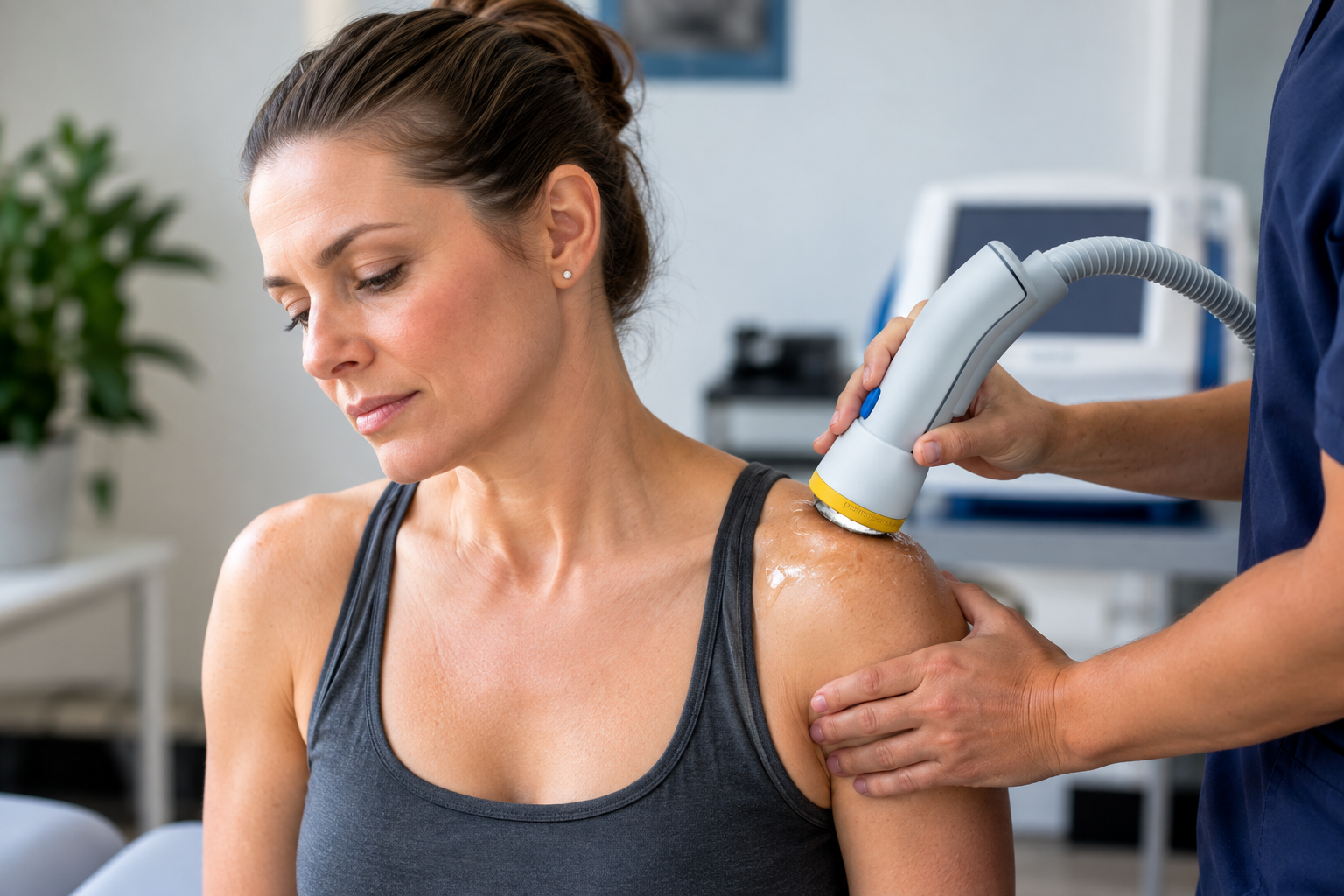
SoftWave is an unfocused, electrohydraulic shockwave device. The applicator is moved across the shoulder — cuff insertion, joint line, bursa, and surrounding musculature — sending broad acoustic pressure waves into the tissue. Cells interpret that mechanical stimulus as a repair signal.
- Angiogenesis: new microvessels form in the poorly perfused cuff, restoring oxygen and nutrient delivery.
- Stem cell activation: resident progenitor cells are mobilized toward the treated tissue.
- Growth factor release: signaling molecules such as VEGF rise, supporting organized collagen remodeling.
- Pain modulation: local nociceptor activity drops, which is why night pain and reaching pain often ease early.
Physiopedia's clinical overview of extracorporeal shockwave therapy summarizes evidence that acoustic waves increase local blood flow, trigger growth factor release, and promote repair in chronic tendon conditions — the process that has stalled in a long-standing shoulder.
Broad focus matters here more than almost anywhere else in the body. Shoulder pain is rarely one pinpoint; the cuff, capsule, bursa, and scapular musculature are usually all involved. A wide treatment field covers that chain in one session, as we explain in SoftWave vs traditional shockwave therapy.
Does it restore mobility as well as reduce pain?
Pain relief and easier sleep usually come first, often within the first two or three visits, because circulation and pain signaling change quickly. Range of motion — reaching overhead, behind the back, into a seatbelt — improves as tissue remodels, and that keeps consolidating for 6 to 12 weeks after the final session.
This is the opposite pattern from a cortisone injection, where relief arrives fast and fades while the underlying degeneration remains; repeated injections may also weaken tendon tissue. The American Academy of Orthopaedic Surgeons reviews these trade-offs in its rotator cuff guidance, and we compare the options directly in SoftWave vs cortisone injections.
What a shoulder treatment plan looks like here
Most shoulder patients complete 6 to 12 sessions, typically one or two per week, depending on whether the picture is a straightforward cuff tendinopathy or a stiffer, frozen shoulder. Each treatment takes about 10 minutes. No needles, no numbing, no downtime — a day of deep tenderness afterward is normal and part of the response.
- Session 1: exam, pain and range-of-motion mapping, and a first treatment so you know how it feels.
- Sessions 2–4: most patients report easier sleep and less pain reaching forward or overhead.
- Sessions 5–12: consolidating the tissue response while progressively reloading the shoulder.
- Weeks after: continued gains as remodeling completes; occasional maintenance for overhead athletes and trades.
We also look at neck and scapular mechanics, since stiffness there quietly increases load on the cuff. More detail lives on our shoulder pain page and rotator cuff pain page.
Who tends to respond best
- Shoulder pain lasting longer than six weeks despite rest and home exercise
- Rotator cuff tendinopathy, bursitis, and early frozen shoulder
- Swimmers, surfers, pickleball and tennis players, and overhead lifters
- Trades and desk workers with posture-driven shoulder load
- Patients hoping to avoid cortisone injections or shoulder surgery
SoftWave isn't right for everyone. Active infection in the treatment area, certain clotting disorders, pregnancy, and some tumor histories are contraindications, and we screen for them at the first visit. Large full-thickness cuff tears may still require surgical consultation.
The bottom line
Chronic shoulder pain usually persists because the tissue lacks the blood supply to finish the repair it began — not because you haven't rested enough. SoftWave targets that bottleneck directly, which for most people means less night pain within weeks and steadier overhead motion over the following months.
See what other patients report in our testimonials, or start with the $49 new patient special — consultation, exam, and a sample SoftWave treatment on one area so you can judge it yourself.
This article is educational and is not medical advice. Individual results vary; a clinical evaluation is required to determine whether SoftWave Therapy is appropriate for your condition.
Ready to find out if SoftWave can help you?
Get our $49 new patient special — consultation, exam, and a sample SoftWave treatment.