Can SoftWave Therapy Help Chronic Elbow Pain?
Elbow pain that lingers for months rarely resolves with rest and braces alone. Here's how SoftWave Therapy for elbow pain targets the degenerated tendon itself — and what recovery typically looks like.
Chronic elbow pain has a way of shrinking your life quietly. Lifting a coffee mug, shaking a hand, gripping a pickleball paddle, typing through a workday — small motions start to hurt, and the pain outlasts every stretch of rest you give it. If you've already tried a counterforce brace, ice, ibuprofen, and six weeks off, and the outside or inside of your elbow still aches, the problem usually isn't effort. It's biology.
That's where SoftWave Therapy for elbow pain fits. Instead of masking symptoms, SoftWave uses broad-focus acoustic waves to stimulate circulation and repair activity inside the tendon that stopped healing. Below is a clear look at why chronic elbow pain stalls, what the therapy does, how quickly people respond, and how we treat it at our Solana Beach clinic.
Why chronic elbow pain doesn't heal on its own
Most persistent elbow pain comes from the tendon attachments at the bony bumps on either side of the joint: the lateral side (tennis elbow, or lateral epicondylitis) or the medial side (golfer's elbow, or medial epicondylitis). Those attachment points carry enormous load through a very small area, and they have limited blood supply.
After the first several weeks, the tissue is no longer truly inflamed. Biopsy studies of long-standing cases show disorganized collagen, abnormal blood vessel ingrowth, and failed repair — a picture clinicians call tendinosis rather than tendinitis. The Mayo Clinic overview of tennis elbow notes that symptoms often persist for six to twelve months or longer, which tracks with what we see: this is a repair problem, not an inflammation problem.
That explains the frustrating pattern. Rest calms the tendon, activity re-irritates it, anti-inflammatories help less and less, and nothing actually rebuilds the tissue. Any treatment that doesn't restore blood flow and cell signaling can reduce pain temporarily without changing the underlying condition.
What SoftWave Therapy does differently
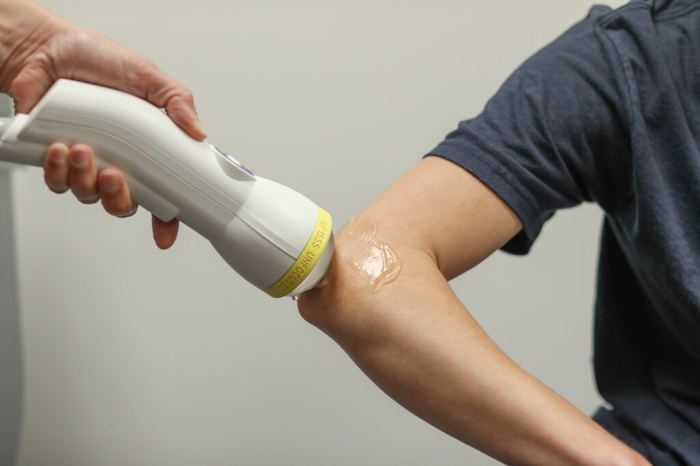
SoftWave is an unfocused, electrohydraulic shockwave device. The applicator is placed over the elbow and forearm and sends broad acoustic pressure waves through the skin into the tendon, its attachment, and the surrounding muscle. Cells read that mechanical stimulus as a signal to start repairing.
- Angiogenesis: new microvessels form in poorly perfused tendon tissue, delivering the oxygen and nutrients repair requires.
- Stem cell activation: resident progenitor cells are mobilized and recruited to the treated area.
- Growth factor release: signaling molecules such as VEGF rise, driving organized collagen remodeling instead of scar buildup.
- Pain modulation: nociceptor activity around the epicondyle is reduced, which is why grip-related pain often eases early.
Physiopedia's clinical overview of extracorporeal shockwave therapy summarizes the evidence that acoustic waves increase local blood flow, trigger growth factor release, and promote tissue repair in chronic tendon conditions — precisely the process that has stalled in a long-standing elbow.
The broad-focus design matters at the elbow. Pain is rarely one pinpoint: the extensor or flexor origin, the tendon body, the joint capsule, and the forearm muscles are usually all involved, and radial or ulnar nerve irritation can ride along with it. A wide treatment field covers that whole chain in a single session. We explain the technology difference in SoftWave vs traditional shockwave therapy.
Does it reduce inflammation and improve arm function?
It's worth separating the two effects. Pain relief and swelling reduction usually appear first, often inside the first two or three visits, because the therapy quickly changes local circulation and pain signaling. Functional gains — grip strength, lifting, backhands, keyboard tolerance — follow as the tendon remodels, and that process keeps consolidating for 6 to 12 weeks after the final session.
That's the reverse of a cortisone injection, where relief arrives fast and then fades while the degeneration remains; repeated injections can also weaken the tendon. The American Academy of Orthopaedic Surgeons discusses this trade-off in its tennis elbow guidance, and we compare the approaches directly in SoftWave vs cortisone injections.
What an elbow treatment plan looks like here
Most elbow patients complete 5 to 8 sessions, typically one or two per week. Each treatment takes about 10 minutes. There are no needles, no numbing, no brace requirement, and no downtime — you're back to your day immediately. A day of deep tenderness afterward is normal and part of the response.
- Session 1: exam, pain mapping across the epicondyle and forearm, and a first treatment so you know how it feels.
- Sessions 2–4: most patients notice easier gripping, lifting, and fewer night aches.
- Sessions 5–8: consolidating the tissue response and reloading the arm progressively.
- Weeks after: continued improvement as remodeling completes; occasional maintenance for heavy racquet or trade work.
We also assess wrist and shoulder mechanics, because poor grip mechanics or a stiff shoulder push extra load into the elbow and drive recurrence. Details live on our tennis elbow treatment page and golfer's elbow treatment page.
Who tends to respond best
- Elbow pain lasting longer than six weeks despite rest, bracing, and stretching
- Tennis, pickleball, and golf players with load-related elbow pain
- Trades, hairstylists, and desk workers with repetitive grip demands
- Patients who want to avoid cortisone injections or tendon release surgery
- Lingering pain after an older elbow strain that never fully recovered
SoftWave isn't appropriate for everyone. Active infection in the treatment area, certain clotting disorders, pregnancy, and some tumor histories are contraindications, and we screen for them at the first visit.
The bottom line
Chronic elbow pain usually persists because the tendon lacks the blood supply to finish the repair it started — not because you haven't rested enough. SoftWave targets that bottleneck directly, and for most people that means less pain with gripping within weeks and steadier arm function over the following months.
See what other patients report in our testimonials, or start with the $49 new patient special — consultation, exam, and a sample SoftWave treatment on one area so you can judge it yourself.
This article is educational and is not medical advice. Individual results vary; a clinical evaluation is required to determine whether SoftWave Therapy is appropriate for your condition.
Ready to find out if SoftWave can help you?
Get our $49 new patient special — consultation, exam, and a sample SoftWave treatment.