
Pelvic Floor Therapy in Solana Beach: What It Is, Who It Helps & What to Expect
Bladder leaks, urgency, postpartum weakness, and post-prostate changes all trace back to the same muscle group. Here's what pelvic floor therapy is, who it helps, and what a REVIVE® session in Solana Beach actually looks like.
Almost nobody thinks about the pelvic floor until it stops doing its job quietly. Then it shows up as a leak when you sneeze, a sudden urge you can't out-walk, two or three trips to the bathroom every night, or a loss of strength and confidence after childbirth or a prostate procedure.
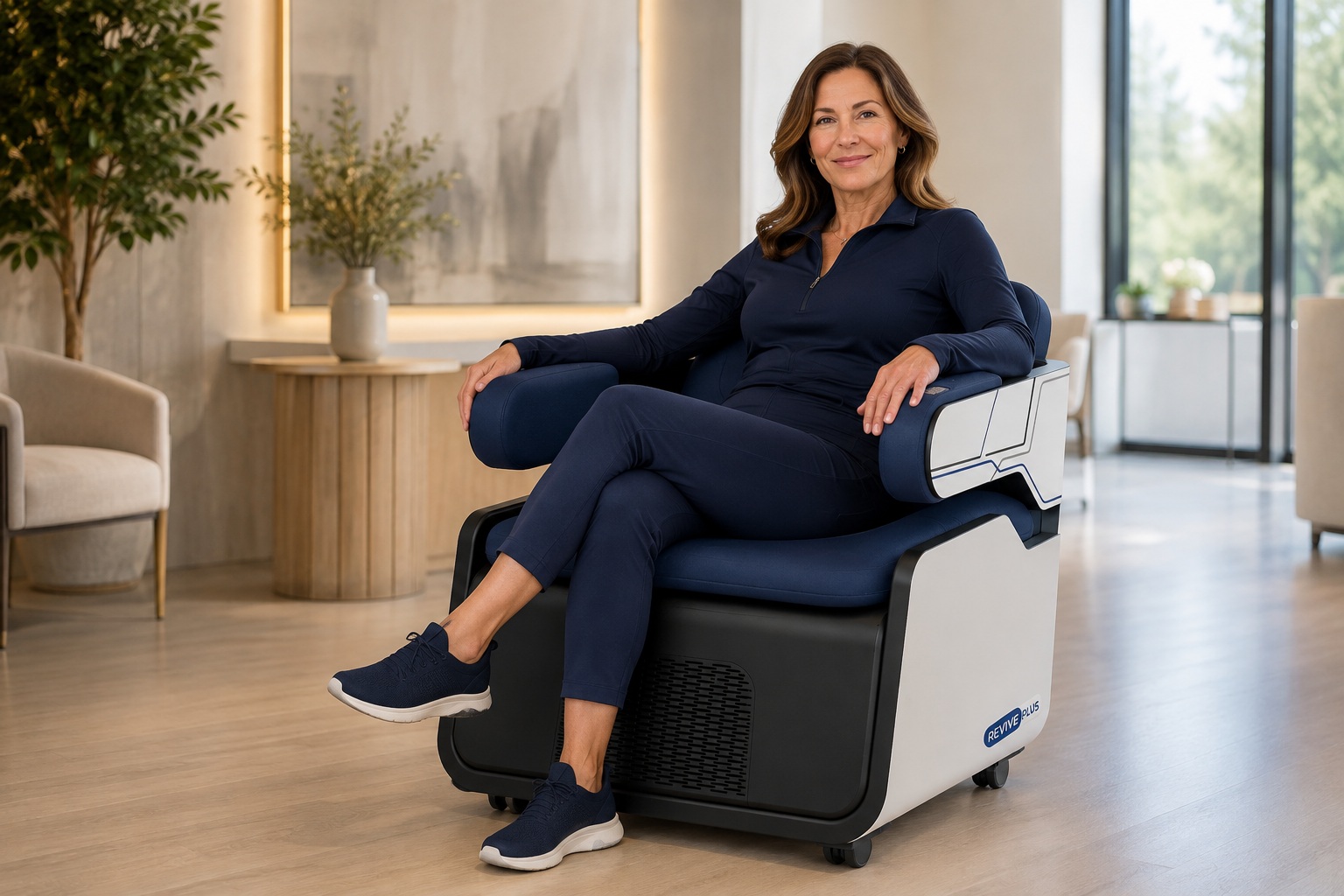
Pelvic floor therapy Solana Beach patients ask about most often is the chair-based kind: you sit fully clothed while an electromagnetic field does the strengthening for you. This guide covers what the pelvic floor does, the signs it needs help, who benefits, and exactly what to expect from a REVIVE® pelvic floor therapy session at our office.
What Is Pelvic Floor Therapy?
Pelvic floor therapy is any treatment aimed at restoring strength, endurance, and coordination to the muscles that form the base of the pelvis. Traditional approaches include guided Kegel programs, biofeedback, manual therapy, and physical therapy. Newer approaches use high-intensity electromagnetic energy to contract the muscles for you — thousands of times per session — without probes, needles, or disrobing.
The goal is the same across methods: a pelvic floor that can contract strongly when you need it, relax fully when you don't, and hold up under everyday pressure like coughing, lifting, or exercise.
What Does the Pelvic Floor Do?
Think of it as a muscular hammock slung between the pubic bone and the tailbone. It has four jobs that rarely get credit until one fails:
- Continence — it closes off the urethra and rectum so you stay dry between bathroom trips.
- Support — it holds the bladder, bowel, and (in women) the uterus in position.
- Stability — it works with the deep abdominals and diaphragm to stabilize the low back and pelvis.
- Sexual function — it contributes to sensation, comfort, erectile rigidity, and orgasm intensity.
The NIH's National Institute of Diabetes and Digestive and Kidney Diseases describes how weakened pelvic muscles contribute directly to bladder control problems in both men and women.
Signs You May Have Pelvic Floor Weakness or Dysfunction
- Leaking urine when you cough, sneeze, laugh, lift, run, or during sex
- Sudden, hard-to-defer urges to urinate
- Frequent daytime bathroom trips or waking at night to go (nocturia)
- A feeling of heaviness, pressure, or bulging in the pelvis
- Reduced sensation, tone, or grip during intimacy
- Weak or unreliable erections, or reduced ejaculatory control
- Core weakness or nagging low back and pelvic discomfort
None of these are an inevitable part of getting older. They're signals from a muscle group that has lost strength or coordination — and muscle responds to training.
Who Can Benefit From Pelvic Floor Therapy?
Broadly: adults with leakage, urgency, frequency, postpartum weakness, mild to moderate prolapse symptoms, post-prostate recovery needs, or sexual function concerns. It's also useful for people who simply can't perform an effective Kegel — a surprisingly common problem, since the muscles are hard to isolate without feedback.
Pelvic Floor Therapy for Women
Women most often come in for stress and urgency leakage, postpartum recovery, vaginal tone and laxity, comfort and satisfaction during sex, and the heaviness that accompanies mild to moderate prolapse. Rebuilding the supporting muscles addresses all of these at the source rather than managing them with pads and planning.
Pelvic Floor Therapy for Men
Men use pelvic floor therapy for bladder leakage and pad dependence, daytime and nighttime urinary frequency, recovery after prostate surgery, and erectile quality. The bulbocavernosus and ischiocavernosus muscles help maintain rigidity — when they're strong and well coordinated, erection quality and control often improve alongside continence.
Bladder Leakage and Urinary Urgency
Stress incontinence (leaks with pressure — coughing, lifting, jumping) and urge incontinence (a sudden need you can't defer) have different mechanics but share a common contributor: a pelvic floor that can't generate or sustain enough closing force. Mayo Clinic's urinary incontinence overview notes that pelvic floor muscle training is a first-line approach for both patterns, and many people have a mix of the two.
Pelvic Floor Therapy After Pregnancy and Childbirth
Pregnancy loads the pelvic floor for months; delivery can stretch and weaken it further. The result may be leaking with exercise, reduced tone, or a sense that your core never quite came back. The American College of Obstetricians and Gynecologists explains how childbirth and aging contribute to pelvic support problems. Postpartum therapy isn't only for new mothers — many women seek it years or decades later, and the muscle still responds.
Pelvic Floor Changes With Aging
Muscle mass and neuromuscular coordination decline with age everywhere in the body, and the pelvic floor is no exception. Hormonal changes around menopause, years of chronic coughing or heavy lifting, and simple disuse all accelerate it. The practical effect is a floor that fatigues faster and leaks sooner — which is precisely why a high-repetition strengthening protocol works well in this population.
Pelvic Floor Therapy After Prostate Procedures
After prostatectomy or other prostate procedures, temporary incontinence is common because the pelvic floor becomes the primary continence mechanism. Rebuilding those muscles is the single most effective way to shorten that recovery window and restore both continence and sexual function. Timing should be coordinated with your urologist.
How the REVIVE® Pelvic Floor Chair Works
The REVIVE® chair generates a high-intensity electromagnetic field that penetrates the entire pelvic floor and triggers supramaximal contractions — contractions stronger than you can produce voluntarily. One session delivers approximately 12,000 of them in 28 minutes.
That's a level of exercise the pelvic floor simply cannot achieve on its own, and it's why roughly 80% of patients report feeling improvement within the first four to six sessions. You don't have to locate the right muscle or hold a contraction correctly — the machine does the work.
What Happens During a Pelvic Floor Therapy Session?
You sit down on the chair, fully clothed, and the intensity is dialed up gradually to a level that's strong but comfortable. Most people describe it as a deep tapping or pulling sensation in the pelvis. You can read, scroll your phone, or talk through the whole thing. When it's done, you stand up and go about your day — no recovery period, no restrictions.
Do You Have to Undress?
No. You stay fully clothed the entire time. There are no probes, no needles, and nothing internal — one of the main reasons people choose chair-based therapy over other options.
How Long Does Treatment Take?
A full session is 28 minutes. The first $69 session is generally shortened to about 15 minutes to avoid the muscle fatigue or soreness that can follow jumping straight into a full-length treatment.
How Many Sessions Might Be Recommended?
Most patients follow a 12- or 18-session protocol: two visits a week for three weeks, a two-week rest, then two visits a week for three more weeks. Your plan is built around your health history, questionnaire score, and symptoms — some people need fewer sessions, some benefit from the longer series.
Pelvic Floor Therapy in Solana Beach
We offer REVIVE® pelvic floor therapy at our Solana Beach office, with private consultations for both women and men. Your first consultation and treatment are just $69, so you can feel the session before committing to a series. Full details, pricing, and the booking calendar are on the pelvic floor therapy page, and you can reach the office any time through our contact page.
If you'd like to know more about the practice and how we approach care first, why patients choose us is a good place to start.
FAQ
Is pelvic floor therapy painful?
No. The contractions are strong but not painful, and intensity is adjusted to your comfort. Some people feel mild muscle soreness after the first session, similar to a workout.
Is the chair only for women?
No — men use it for leakage, urinary frequency, post-prostate recovery, and erectile quality.
How soon might I notice a change?
About 80% of patients report improvement within four to six sessions. Individual results vary.
Can I use HSA or FSA funds?
Yes. HSA/FSA, CareCredit, and in-house payment options are accepted.
This article is educational and is not medical advice. Individual results vary. New, severe, or worsening urinary, pelvic, or sexual symptoms should be evaluated by a qualified healthcare professional.
Ready to find out if SoftWave can help you?
Get our $49 new patient special — consultation, exam, and a sample SoftWave treatment.