
Can SoftWave Therapy Help Plantar Fasciitis Heal Faster?
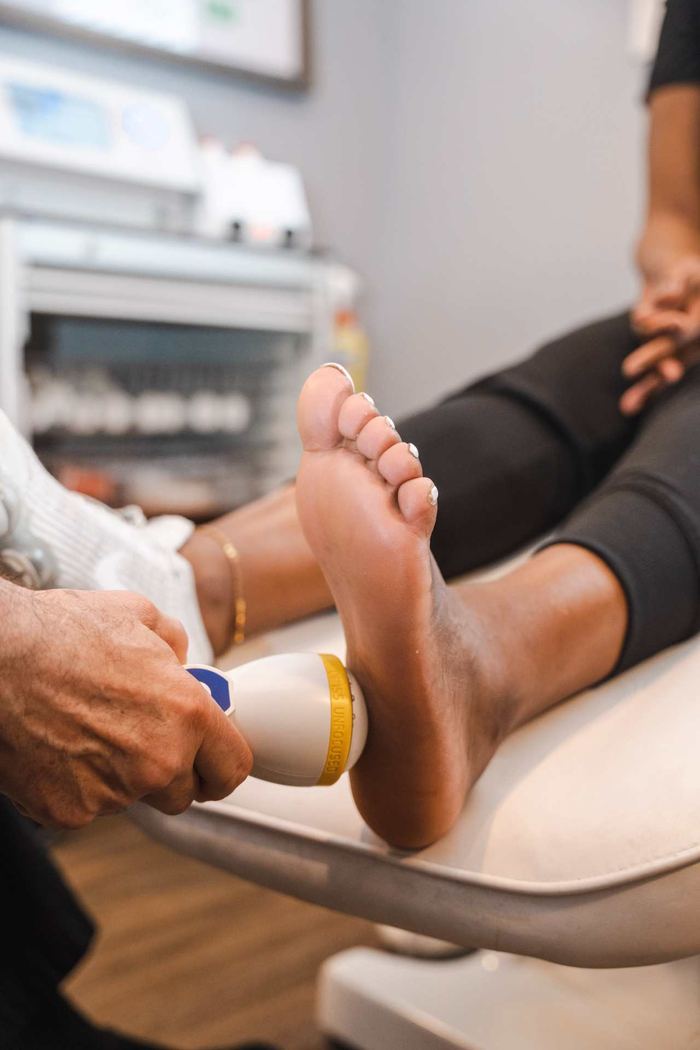
Morning heel pain that won't quit? Here's how SoftWave Therapy for plantar fasciitis targets the degenerated fascia itself — and why it can speed up healing when stretching, orthotics, and injections stall out.
That first step out of bed — the one that feels like a nail driving into your heel — is the calling card of plantar fasciitis. For many people it fades after a few weeks of stretching and better shoes. For others it drags on for months or years, surviving orthotics, night splints, taping, and even cortisone. If you're in that second group, the question isn't whether you should keep resting. It's whether anything can actually restart healing in the tissue itself.
That's the specific problem SoftWave Therapy for plantar fasciitis is designed to solve. Rather than masking pain or offloading the arch, SoftWave uses broad-focus acoustic waves to stimulate blood flow and repair activity inside the fascia. Below is a straight look at how it works, what the research supports, how fast people typically respond, and how we run plantar fasciitis care at our Solana Beach clinic.
Why plantar fasciitis heals so slowly
The plantar fascia is a thick band of connective tissue running from the heel bone to the base of the toes. It has a poor blood supply by design — it's built for load transfer, not for metabolic activity. When it gets repeatedly overloaded, micro-damage accumulates faster than the body can repair it.
Within a few months the tissue stops behaving like an inflamed structure and starts behaving like a degenerated one. Pathology studies of chronic cases show collagen disorganization and failed repair rather than active inflammation — which is why anti-inflammatories often disappoint after the early weeks. The Mayo Clinic overview of plantar fasciitis notes that symptoms commonly persist for many months, and stubborn cases are the norm rather than the exception.
So the healing bottleneck is circulation and cellular signaling — not stretch length and not inflammation. Any treatment that doesn't address that bottleneck can relieve symptoms without changing the timeline.
How SoftWave Therapy changes the timeline
SoftWave is an unfocused, broad-spectrum electrohydraulic shockwave device. The applicator sits on the heel and arch and sends acoustic pressure waves through the skin into the fascia, the fat pad, and the surrounding attachments. Those waves create a mechanical stimulus that cells interpret as a signal to repair.
- Angiogenesis: new microvessels form in tissue that previously had little blood flow, delivering oxygen and nutrients to the repair site.
- Stem cell activation and recruitment: resident progenitor cells are mobilized to the treated area.
- Growth factor release: signaling molecules such as VEGF increase, driving collagen remodeling rather than scar accumulation.
- Reduced pain signaling: mechanoreceptor and nociceptor activity in the heel is modulated, which is why many patients notice a change in morning pain early.
This regenerative response is what separates shockwave from pain-masking care. Physiopedia's clinical overview of extracorporeal shockwave therapy summarizes the evidence that acoustic waves increase local blood flow, stimulate growth factor release, and promote tissue repair in chronic tendon and fascia conditions — exactly the biology stalled in a long-standing plantar fascia.
The broad-focus part matters for the heel specifically. Plantar fasciitis pain is rarely one pinpoint — it involves the calcaneal attachment, the fascia body, the fat pad, and often the calf and Achilles complex. A wide treatment field covers that entire chain in one session. We break the technology difference down further in our guide to SoftWave vs traditional shockwave therapy.
Does it actually heal faster — or just hurt less?
Both, and it's worth separating them. Pain relief usually shows up first, often within the first two or three sessions, because the therapy quickly changes how the heel's pain receptors behave. Structural change lags behind: the collagen remodeling and new vascular supply take weeks to consolidate, which is why the full benefit often keeps building for 6 to 12 weeks after the last session.
That's the opposite pattern from a cortisone injection, where relief is fast and then fades as the underlying degeneration remains — and repeated injections can weaken the fascia and raise rupture risk. We compare the two approaches directly in SoftWave vs cortisone injections.
What a plantar fasciitis plan looks like here
Most heel pain patients complete 5 to 8 sessions, usually one or two per week. Each treatment takes about 10 minutes on the table. There's no numbing, no needles, no boot, and no downtime — you walk in, get treated, and walk out. Some people feel a deep ache or tenderness for a day afterward, which is a normal part of the response.
- Session 1: exam, pain mapping across the heel and arch, and a first treatment so you know how it feels.
- Sessions 2–4: most patients report easier first steps in the morning and less pain after long standing.
- Sessions 5–8: consolidating the tissue response and returning to running, hiking, or standing shifts.
- Weeks after: continued improvement as remodeling finishes; occasional maintenance visits for high-mileage feet.
We keep working on the calf and Achilles as well, since limited ankle dorsiflexion is one of the biggest drivers of recurring heel load. The American Academy of Orthopaedic Surgeons lists tight calf muscles among the leading risk factors for plantar fasciitis, so addressing them protects the result you just paid for.
Who tends to respond best
- Heel pain that's lasted longer than six weeks despite stretching and shoe changes
- Runners, hikers, pickleball and tennis players with load-related heel pain
- People on their feet all day — nurses, teachers, servers, trades
- Patients who want to avoid cortisone injections or plantar fascia release surgery
- Cases with a diagnosed heel spur, where the pain is coming from the irritated fascia attachment
SoftWave isn't right for everyone. Active infection in the area, certain blood-clotting disorders, pregnancy, and some tumor histories are contraindications, and we screen for these at the first visit.
The bottom line
If your plantar fasciitis is stuck, it's usually not because you haven't stretched enough — it's because the fascia lacks the blood supply to finish the repair it started. SoftWave targets that directly, and for most people that means less morning pain within weeks and a faster path back to normal walking, running, and standing.
Learn more on our plantar fasciitis treatment page, see what other patients say in our testimonials, or start with the $49 new patient special — consultation, exam, and a sample SoftWave treatment so you can judge it for yourself.
This article is educational and is not medical advice. Individual results vary; a clinical evaluation is required to determine whether SoftWave Therapy is appropriate for your condition.
Ready to find out if SoftWave can help you?
Get our $49 new patient special — consultation, exam, and a sample SoftWave treatment.